The best of Prog rock

Saturday, May 17, 2014

ST. JOHN´S UNIVERSITY - UNFORGETTABLE MOMENTS

During the first two months of 2014 a group of Brazilian English teachers (I was one of them) had the opportunity of taking a course at St. John´s University in Manhattan, NYC. It was a great, spectacular, unforgettable experience for all of us because besides learning new teaching strategies and technologies we could interact a lot with native and foreign teachers, people on the streets and classmates, changing experiences and learning new things as well.

The university:
St. John´s is a private Roman Catholic University founded in 1870 with campuses in Manhattan, Queens and Staten Island (New York City), a graduate center in Oakdale (New York) and also abroad, one in Rome and another in Paris.
The building where we studied in Manhattan was sold for $223 million to a partnership between Fisher Brothers and The Whitkoff Group;
The transaction represents the largest sale in Lower Manhattan, a record price for the area, according to Cushman & Wakefield, which represented St. John’s.
Located on the northeast corner of Murray and West streets, the campus has a 31,028 square-foot footprint and allows for the development of a residential building totaling 310,028 square feet.
Fisher Brothers and Witkoff Group said they plan to demolish the property at 101 Murray Street and replace it with a new mixed-use building incorporating residential and commercial spaces.
"Lower Manhattan continues to evolve at a record-setting pace and we are proud to be a part of it, along with The Witkoff Group,”Winston Fisher, partner at Fisher Brothers, said in a statement. 
The university will continue to occupy the Manhattan campus until mid-2014 and plans to find another centrally located space in Manhattan before the start of the 2015 academic year.
“The university takes great pride in our presence in New York City, and the overwhelming success of this transaction allows us to ensure the strength of that presence for generations of St. John’s students to come,” Martha Hirst, executive vice president, chief operating officer and treasurer at St. John’s University, said.
Queens Campus:

Tuesday, May 13, 2014

FUNNY SIGNS TO PRACTICE ENGLISH (AND LAUGH AS WELL)

Here is a selection of funny signs in English for your enjoyment. 
Milton França


Milton França
email: miltonfranca@gmail.com
facebook: facebook.com/miltonbfranca
whatsapp: +559881698919

Thursday, May 8, 2014

ENGLISH TEST - UNICENTRO 2014


Read the following text and answer questions 1 to 3.

Actress and humanitarian Angelina Jolie Voight was born in Los Angeles, California, on June 4, 1975. She starred in the HBO biopic Gia before earning an Academy Award for best supporting actress for Girl, Interrupted. Jolie has become one of Hollywood’s top marquee names, having starred in movies like Wanted, Mr. and Mrs. Smith, Salt and Changeling. She’s also directed the film In the Land of Blood and Honey. In October 2008, Jolie appeared in the Clint Eastwood-directed thriller Changeling, for which she received an Oscar nomination for best actress.
She is coupled with actor Brad Pitt and has a big family. Jolie first adopted Maddox, her first son. Three years later, Jolie adopted a daughter, Zahara. The couple’s first biological daughter, Shiloh, was born in 2006. In March 2007, Jolie added a new member to her family, she adopted another boy. In 2008, she gave birth to twins.
A devoted humanitarian, Angelina Jolie was made a Goodwill Ambassador for the UN Refugee Agency in 2001. She has made headlines for her work to obtain aid for refugees in Cambodia, Darfur and Jordan, to name just a few. In 2005, Jolie received the Global Humanitarian Action Award from the United Nations Association of the USA for her activism on behalf of refugee rights.
In May 2013, 37-year-old Jolie announced in a New York Times op-ed article titled My Medical Choice that she underwent a double mastectomy in an effort to prevent breast cancer in the future. The actress said she decided to undergo the surgery after learning that she carries a gene known as BRCA1, which increases the risk of both breast and ovarian cancer. The news made headlines all over the world.
(Adapted from: Angelina Jolie’s Biography. Source: . Accessed on: 14 jul. 2013.)

1. According to the text, Angelina Jolie has received an
a) Academy Award for best actress.
b) Academy Award for best director.
c) Oscar for best supporting actress.
d) Oscar Nomination for best director.
e) MTV Movie Award for best performance.

2.  How many children does Angelina Jolie have, both adopted and biological?
a) 2                 
b) 3                 
c) 4                             
d) 5                 
e) 6

Based on the text about Angelina Jolie, assign T (true) or F (false) to the following statements.
(  ) She has made headlines because of her involvement in sex scandals.
(  ) She has more adopted children than biological ones.
(  ) She has recently made public she has undergone surgery to prevent a disease.
(  ) She has won an award in recognition of her humanitarian activism.
(  ) She is known for both her acting career and humanitarian activism.

3. Choose the alternative that shows, top-down, the correct sequence.
a) T, T, F, T, F.
b) T, F, T, F, T.
c) F, T, T, F, F.
d) F, T, F, F, T.
e) F, F, T, T, T.

Read the following book review and answer questions 4 and 5.
The Great Gatsby is probably F. Scott Fitzgerald’s greatest novel, a book that offers damning and insightful views of the American nouveau riche in the 1920s. The Great Gatsby is an American classic and a wonderfully evocative work.

Like much of Fitzgerald’s prose, it is neat and well crafted. Fitzgerald seems to have had a brilliant understanding of lives that are corrupted by greed and incredibly sad and unfulfilled. The novel is a product of its generation with one of American literature’s most powerful characters in the figure of Jay Gatsby, who is urbane and world-weary. Gatsby is really nothing more than a man desperate for love.
(Adapted from: The Great Gatsby Review. Source: .
Accessed on: 14 jul. 2013.)

4. Based on the review, it is correct to assert that
a) The Great Gatsby is one of F. Scott Fitzgerald’s minor works of prose.
b) The Great Gatsby is unlike most of Scott Fitzgerald’s prose.
c) the book depicts the lifestyle of newly wealthy Americans in the 1920s.
d) the novel is poorly written and shows the lack of writing skills of its author.
e) the novel portrays a number of powerful characters, except for Jay Gatsby.
5
According to what is stated in the review, consider the following statements.
I. Fitzgerald shows in his novel an understanding of the corruption greed can cause.
II. The Great Gatsby portrays lives fulfilled by love and professional satisfaction.
III. The novel reflects the lifestyle of a generation of American literature writers.
IV. The main character, Gatsby, represents someone who is in despair for love.

5. Choose the correct alternative.
a) Only the statements I and II are correct.
b) Only the statements I and IV are correct.
c) Only the statements III and IV are correct.
d) Only the statements I, II and III are correct.
e) Only the statements II, III and IV are correct.

Read the following text and answer questions 6 to 8.
São Paulo, Brazil – Protesters showed up by the thousands in Brazil’s largest cities on Monday night in a remarkable display of strength for an agitation that had begun with small protests against bus-fare increases, then evolved into a broader movement by groups and individuals irate over a range of issues including the country’s high cost of living and lavish new stadium project costs.
The growing protests rank among the largest and most resonant since the nation’s military dictatorship ended in 1985, with demonstrators numbering into the tens of thousands gathered here in São Paulo, Brazil’s largest city, and other large protests unfolding in cities like Rio de Janeiro, Salvador, Curitiba, Belem and Brasília, the capital, where marchers made their way to the roof of Congress.
Sharing a parallel with the antigovernment protests in Turkey, the demonstrations in Brazil intensified after a harsh police crackdown last week stunned many citizens. In images shared widely on social media, the police here were seen beating unarmed protesters with batons and dispersing crowds by firing rubber bullets and tear gas into their midst.    
“The largest protests are happening in cities which will host World Cup Games,” said Mr. Malini, a scholar who analyzes data patterns in social media at the Federal University of Espírito Santo. “Brazilians are mixing soccer and politics in a way that is new, and minority voices are making themselves heard.”
(ROMERO, S. Thousands Gather for Protests in Brazil’s Largest Cities. The New York Times. Source:
2013/06/18/world/americas/thousands-gather-for-protests-in-brazils-largest-cities.html>. Accessed on: 9 jul. 2013.)
6
6. Among the motivations for the protests held in Brazil mentioned in the text are
a) claims for changes in election rules and regulations.
b) crisis in the elementary educational system.
c) fight against a law that reduces criminal responsibility age.
d) indignation over the impressive expenses of sports stadiums.
e) the enormous salaries and gratifications of politicians.
7
7. According to the text, it is correct to say that
a) protest became more intense because of police severe repression.
b) protests started as an objection to the World Cup Game being held in Brazil.
c) social media was left out as a means to help release news related to protests.
d) the protests are believed to be ineffective due to small number of participants.
e) there was little, if any, space for varied topics during the manifestations.

About the protests in Brazil, according to the text, consider the following statements.
I. It can be compared to protests against government in Turkey.
II. With the protests minorities are having their claims heard.
III. The manifestations happened without any violent incident.
IV. Protesters kept a distance from government buildings.

8. Choose the correct alternative.
a) Only the statements I and II are correct.
b) Only the statements I and IV are correct.
c) Only the statements III and IV are correct.
d) Only the statements I, II and III are correct.
e) Only the statements II, III and IV are correct.

Observe the following editorial cartoon and answer questions 9 and 10.

9. According to what the man says, we can infer that he believes
a) parents should join their kids in their activities.
b) playing football daily prevents one from putting on weight.
c) it is wise for parents to support their children’s sports practice.
d) kids need to be engaged in intellectual activities as well as sports.
e) kids need to play sports for a certain amount of hours daily.

10. The editorial cartoon addresses a common issue parents deal with, which is
a) children refuse to help with chores around the house when asked.
b) kids nowadays are less obedient and cause their parents trouble.
c) kids refuse to do their homework and as a consequence go bad at school.
d) many kids are choosing electronic games over sports or outdoors activities.
e) parents are often called at schools to discuss their kids learning problems.

Thursday, May 1, 2014

SPANISH POLICE ARREST BANANA THROWER


The police in Spain say that they have arrested the spectator who threw the banana at Barcelona defender Daniel Alves on April 27.
The racist incident happened when the player was going to take a corner in a match against Villarreal. He responded by peeling the fruit and eating it and this act received praise and campaigns against racism on the web all over the world.
The man who was detained has been identified as a 26-year-old Villarreal supporter named as David Campaya Lleo.
The club said the man involved had had his season ticket withdrawn and been given a lifetime ban.
Daniel Alves said that it was "not an isolated incident", and that he had been denouncing racist insults for over six years.
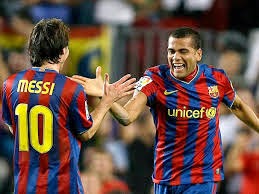
"I hope that this (campaign) can be an alert to ban this kind of attitude from football altogether. I hope the debate about racial prejudice will not fade away, but stays on permanently and not be restricted only to football," he added.
He criticized Spain saying that they sell the country as being first world but in certain things they are very backward.
Alves also said that he wanted the opposition fan who threw the banana to be publicly shamed.

Villarreal said the club deeply regrets and condemns the incident.

The hashtag "we are all monkeys" took Twitter by storm after the Brazilian player Neymar tweeted a photo of himself smiling on Instagram with a banana, side by side with his toddler son.
Professional players, celebrities and ordinary people have posted photos of themselves, banana in hand, on social media. I am one of them: see above.

Tuesday, April 29, 2014

DANIEL ALVES EATS BANANA THROWN AT HIM DURING A SOCCER MATCH


Racism has been a reoccurring issue in soccer for years and unfortunately another incident occurred on April 27 at a game between Barcelona and Villarreal when a banana was thrown at Daniel Alves.
The defender was going to take a corner during the match between Barcelona and Villarreal when a fan threw a banana that landed at his feet. He simply picked up the banana, peeled it, took a bite and continued to play.
Daniel Alves is not the first player to experience racist taunting during a competition but he is one of the first to respond with humor.  When he saw the banana, he treated it as if it were a snack.
Shortly after the banana incident, Alves launched a cross that Mateo Musacchio headed into his own goal before Lionel Messi scored Barcelona's winner.
After the match he said that humor is the best way to combat racism in sports.

"We have suffered this in Spain for some time," Alves said. If you don't give it importance, they won't achieve their objective."

The episode spread worldwide. Barcelona and Villarreal have already manifested against it. Stars and athletes have posted photos with bananas showing the player their support and condemning racist acts.
Manchester City Argentine attacker Sergio Agüero tweeted "We say no to racism. We are all equal". He posted a picture eating a banana together with Brazilian player Marta.
Talisca Reis, Brazilian taekwondo fighter, has also joined the movement posting a photo holding a banana. "Say no to prejudice", she wrote.
Among celebrities, the singer Alexandre Pires posted a picture of himself eating the fruit: "Here's the banana!! #SOMOSTODOSMACACOS". TV hosts Luciano Huck and Angélica also mentioned the incident on Facebook.
Fifa released an official statement condemning the episode and assured the upcoming World Cup will be a good opportunity to reinforce the war against racism.
"Fifa condemns any type of discrimination and it is sad to see such racist incidents continue to occur in football. We keep asking the football community to unite and to use their voces to eradicate racism from football and society".
"The 2014 FIFA World Cup in Brazil will be the perfect occasion to send a clear message to the world: football is for all and we will not tolerate any form of discrimination", said the entity.

Wednesday, April 23, 2014

ORPHANED LAND - A BAND FROM ISRAEL

Orphaned Land is a progressive metal band from Israel, formed in 1991 under the name Resurrection (changing their name in 1992 to the current name), that combines Jewish and Arabian influences. The band has gone through several changes over the years, but has retained two of the founding members, Kobi Farhi (vocals) and Uri Zelcha (bass). They are joined by Matan Shmuely (drums) as well as Chen Balbus (guitar/keyboard), who replaced the founding member, Matti Svatizky in 2012. Co-Founding member Yossi Sassi (guitars/strings) left the band in early 2014. Their lyrics promote a message of peace and unity, particularly between the three main Abrahamic religions: Judaism, Islam, and Christianity.
In 1992, the band changed its name from the original Resurrection to Orphaned Land. Orphaned Land fuse progressive and death metal as well as Middle-Eastern folk music and Arabic traditions in a form of Oriental metal. Each album has some concept related to two extreme: a meeting of East and West, past and present, light and darkness, and God and Satan.
The band’s first album was Sahara (1994) which was originally released as a demo. The second album, El Norra Alila (1996), had many Eastern/Oriental influences, such as "El Norra Alila" ("Illustrious God"), based on a poem sung during Yom Kippur as a plea of forgiveness. It also included songs with traditional oriental Jewish piyyut and Arabic melodies. The album explored the themes of light and darkness, as well as conveying the message of commonality between the three Abrahamic religions.
In 2008, Orphaned Land was featured in the documentary Global Metal, a film by the creators of Metal: A Headbanger's Journey.
On May 22, 2010, Orphaned Land performed as the opening act to Metallica's show in Israel. Following this, the band went on a festival tour in the summer of 2010, promoting their latest album, The Never Ending Way of ORWarriOR, with appearances at such festivals as Wacken Open Air, Summer Breeze Open Air, Sonisphere Festival, Gods of Metal, Rock Hard Festival and more.  
On June 11, 2012, guitarist Matty Svatitzky announced his departure from the band, due to personal issues. Matti Svatitzky was replaced by Chen Balbus, a young musician who was a replacement guitar player for some live shows, before he became an official member. Chen instantly became an integral part of the composing, writing, producing and recording of the new album, "All Is One.
In 2012 there was an online petition for Orphaned Land to be awarded a Nobel Prize for their commitment to allowing the Arab World to listen to their music despite bans on such a thing from Arab League countries.

                                                                                    Adapted from www.wikipedia.com by Milton França

If you don´t know the band, take a look at these videos:


Thursday, January 16, 2014

PRISONS IN BRAZIL

                                                Welcome to the Middle Ages

                Brazil’s hellish penal system is overcrowded, violent and brutalising
FLIP-FLOPPED feet saunter across a wet concrete floor. With each step, the water reddens until the camera comes to rest on the bodies of three prisoners. Severed heads lie on top of two of the corpses. The video was filmed in Pedrinhas, the biggest prison complex in the northern state of Maranhão, and published on January 7th by Folha de São Paulo, a newspaper. The footage has woken up many Brazilians to the hellishness of their prisons.
At least 218 inmates have been murdered since January 2013 in 24 of Brazil’s 27 states. (The other three do not disclose figures.) Dozens more have died in suspicious circumstances. Severe overcrowding is the root of the problem. In the past 20 years Brazil’s population has grown by 30%, while that of its prisons and police cells has almost quintupled, to 550,000—the fourth-highest in the world, behind the United States, China and Russia.
Officially, Brazilian penitentiaries have room for around 300,000 people. There is federal money to spend on building extra prisons, which are largely run by the states. But it can flow only once a project is approved by a local town. They are reluctant hosts, fearing that penitentiaries both bring crime when prisoners are released and also divert resources from other public works. “Everyone wants hospitals and schools,” says Antonio Ferreira Pinto, a former security secretary in São Paulo state. “No one wants a prison.” Federal-prison spending fell in 2012.
Brazil needs cells to house genuine criminals: the murder rate stood at 24.3 per 100,000 in 2012, more than six times higher than in Chile. But really it needs fewer inmates. Lucia Nader of Conectas, a human-rights group, attributes an upsurge in prisoners since 2006 to a law that decriminalised possession of drugs for personal use but stiffened penalties for trafficking. The distinction between the two is left to the arresting officer. “A light-skinned yuppie smoking pot on the beach is a user and left in peace,” says Ms Nader. “A dark-skinned slum-dweller lighting a spliff on the street is a peddler and thrown in jail.” Since the law’s introduction, the number of people held for trafficking has swelled from 33,000 in 2005 to 138,000 in 2012.
This flood of inmates hits two bottlenecks, says Julita Lemgruber, a former director of Rio de Janeiro’s prisons department and now an academic at Candido Mendes University. At the “entrance” 41% of all prisoners languish in pre-trial detention. Ms Lemgruber and colleagues have found that half of the 5,000 or so pre-trial detainees in Rio whose cases made it to court in 2012 ended up without a prison sentence. At the “exit”, meanwhile, convicts do not benefit from Brazil’s theoretically world-class laws on parole and alternative sentences like community service.
A shortage of legal advice for prisoners helps to explain both bottlenecks. Most detainees cannot afford a lawyer and public defenders are in short supply. The federal government has pledged to send a task-force of lawyers to plough through a backlog of cases in Maranhão. It is not clear how that will help prisons elsewhere. For each public attorney in São Paulo’s main criminal court, 2,500 cases are pending.
With too many prisoners flowing in, and not enough flowing out, a cesspool festers in the middle. On paper Brazil’s prisons are a paragon of modernity. In practice, says Marcos Fuchs of Instituto Pro Bono, another human-rights group, they are medieval. In one São Paulo penitentiary he visited, 62 people were crammed in a cell meant for 12, taking turns to sleep on the floor or by leaning against a wall. According to official figures, half a million inmates received care from 367 doctors in 2012. Fifteen gynaecologists served 32,000 female prisoners, many of whom use bread to stanch menstrual bleeding.
Dante would blanch
Criminal gangs have filled the vacuum left by the state. In exchange for loyalty and a membership fee, gangs offer protection, bring supplies (including sanitary towels), bus families in for visits and even pay for lawyers. They also maintain order—until a rival outfit emerges. A challenge to an established gang seems to have been behind the violence in Pedrinhas.
Brazil’s criminal code includes neither the death penalty nor a life sentence. In theory, every inmate will re-emerge into the outside world. But they do so brutalised, lacking skills and ostracised by a society with a punitive attitude towards criminals. That pushes recidivism rates above 60%, starting the ghastly cycle anew.
                                                                                      

                                                        Adapted from The Economist